Published on December 16, 2025 | MindBody Journal
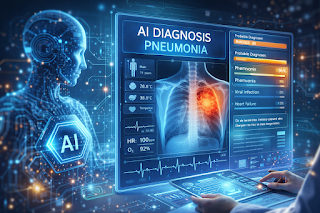
Pneumonia and other lung infections are still among the leading causes of death worldwide, yet diagnosing them correctly—especially in very sick patients—can be surprisingly difficult. Even in modern intensive care units, doctors often have to make fast decisions with limited information, which sometimes leads to unnecessary antibiotic use.
Now, researchers at the University of California, San Francisco (UCSF) have developed an exciting new approach that could change this forever. By combining artificial intelligence (AI) with a simple biological marker, they were able to diagnose lung infections with remarkable accuracy.

🔬 A Smarter Way to Diagnose Lung Infections
The UCSF research team tested a new diagnostic model that uses:
AI to analyze medical records, and
A biomarker called FABP4, which helps detect infections deep in the lungs
When these two tools were used together, the model correctly identified lung infections 96% of the time—a level of accuracy higher than standard clinical diagnosis in intensive care units.
Even more impressive, the model was able to clearly tell the difference between:
✔ Infectious causes (like pneumonia)
✔ Non-infectious causes of breathing failure

💊 Why This Matters: Fewer Unnecessary Antibiotics
One of the biggest problems in hospitals today is overuse of antibiotics. Doctors often prescribe them “just in case,” because missing an infection can be deadly.
According to the researchers, if this AI-based tool had been available when patients were admitted, it could have reduced inappropriate antibiotic use by over 80%. That’s a major step forward in fighting antibiotic resistance, one of the biggest global health threats.
“This method gives results much faster than traditional cultures and could be easily used in hospitals,”
— Dr. Chaz Langelier, Associate Professor of Medicine, UCSF
🧬 What Is FABP4 and Why Is It Important?
FABP4 is a gene involved in inflammation. The researchers discovered that:
It is less active in immune cells
More specific to lung tissue
This makes it a powerful signal for detecting true lung infections, rather than inflammation caused by other problems.
🧪 What the Study Looked At
The study included 157 critically ill patients:
98 patients before COVID-19, mostly with bacterial infections
59 patients during the COVID-19 pandemic, mostly with viral infections
When tested separately:
AI alone was about 80% accurate
The biomarker alone was also about 80% accurate
But when combined, accuracy jumped to 96%.
🤖 AI vs Doctors: Working Together, Not Competing
The AI system (based on GPT-4 and used on a privacy-protected platform) performed just as well as experienced doctors who specialize in infectious diseases.
Interestingly:
AI focused more on chest X-ray reports
Doctors relied more on clinical notes
This shows how AI can support doctors, not replace them—offering a second, unbiased perspective.
“It highlights how AI can complement clinical thinking,”
— Dr. Natasha Spottiswoode, Assistant Professor of Medicine, UCSF
🚑 What’s Coming Next?
The UCSF team is now:
Validating this model for real-world hospital use
Expanding their research to sepsis, a condition that remains extremely difficult to diagnose and is a leading cause of hospital deaths
🌍 Final Thoughts
This breakthrough shows how AI and medicine can work together to:
✔ Diagnose infections faster
✔ Reduce unnecessary antibiotics
✔ Improve patient safety
✔ Support doctors in critical decisionsAs healthcare continues to evolve, innovations like this bring us closer to more accurate, personalized, and safer medical care.